
A work in progress . . . keep checking back!
Waterman offered pens with precious metal overlays from very early on in the company's history. Not the first, but surely the most popular of the patterns offered was "Filigree" -- not true filigree, which is wirework, but pierced-work, allowing the hard rubber (and on very late examples, celluloid) underneath to show through. Waterman's Filigree pattern changed over time, though its name did not. The pictures below show the most common variations. Although most are shown in sterling silver, they were offered in gold filled and solid 14K gold as well. The use of the term "filigree" to describe this sort of work was widespread in the American jewelry trade of the era, and being generic and descriptive, was ineligible for protection under U.S. copyright and trademark law. Many of Waterman's competitors -- Parker, Conklin, and Sheaffer, to name but a few -- also advertised "filigree" pens with similar pierced sheet-metal overlays.
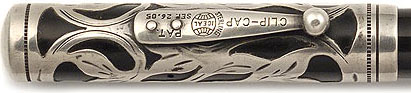
The Filigree pattern above was in use from 1907 to c. 1923, and is most commonly found on eyedropper-fillers -- though it was also used on coin-fillers, pump-fillers, safeties, and older lever-fillers. The design is Art Nouveau, and may be described as a trefoil vine pattern.
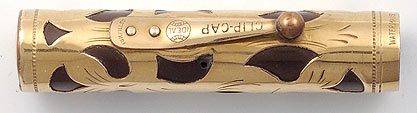
Another example of the trefoil vine pattern appears above. The blockier, more abstract treatment places it later in the pattern's run The cap's flatter crown is also indicative of a later date of production.
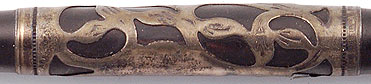
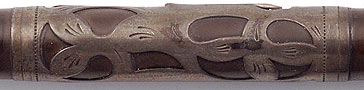
Two more examples, showing variations within the most common version of the trefoil vine pattern.
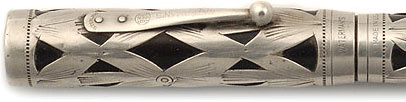
By the time the 1925 Waterman catalog was published, the trefoil vine pattern had been supplanted by a new Filigree, shown above. It has been variously dubbed "basketweave" or "bamboo" by collectors. The geometricized handling of a motif ultimately drawn from the natural world is characteristically Art Deco.

The half-size LEC above is slenderer than the 452 above it, but the altered proportions of the Filigree pattern do not appear to reflect a substantially different production date. The same 1925 catalog shows both forms of this pattern, with the lower version appearing on smaller and slenderer models. Despite the "basketweave" monicker, these later Filigrees seem to be a simplified version of a rather short-lived pattern that is shown on the ½V-size eyedroppers and lever-fillers in Waterman's 1919 catalog, in which the intersections of six strips (five, next to the barrel indicia panel) with the round central boss are quite clearly rendered as connected six-petaled flowers.

While the patterns shown above are the most common, other Filigree patterns preceded them. These precursors are scarce; they appear to have been introduced towards the end of the 1890s, with most being made of fine silver -- .999 pure, as opposed to the .925 of sterling. Most, probably all, were made by electrodeposition: the overlays were literally plated onto the caps and barrels. The piercings were then cut out by hand, and the overlays further enhanced with engraved lines. In some cases, the piercing may have been done by reverse electrodeposition, but in most fine silver overlays, the marks left by the cutting tool are clearly visible on the hard rubber.
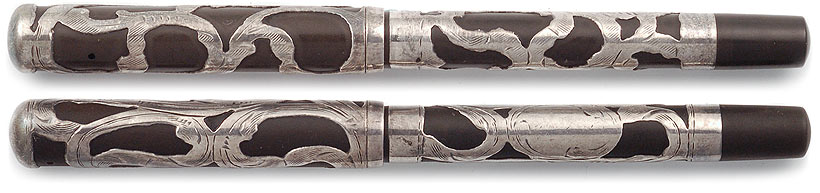
Above are two very early Waterman 12 Filigree pens. Both have the narrow feed that predated the "Spoon Feed", which indicates a date prior to c. 1901. This Filigree pattern appears in Waterman ads from around 1899 to 1903.

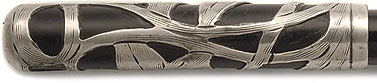
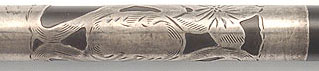
Almost all fine silver Filigree overlays are found on slip-cap eyedropper-fillers of "cone-cap" form -- that is, the 1X series, with 12 and 14 being the most common models. Barrel ends bear two-digit codes; the use of three or four-digit model code stamps for Filigree pens began only some time after the manufacture of fine silver overlays ended (this would appear to have been in the fall of 1908; Waterman literature began to use the 41X model number format earlier, by the end of 1907). Despite their short production run, fine silver Filigree overlays are found in a great number of variations. Most are quite thin and flat, but some have substantial thickness. Some are purely abstract, while others incorporate large flowers or leaves on cap or barrel, or less commonly, both. All are strongly Art Nouveau in style, with flowing lines and asymmetrical, organic compositions that offer a stark contrast to the comparatively rigid and regularized patterns that followed. Fine silver is much softer than sterling, so these overlays are often found with damage or badly worn imprints.
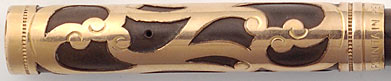
An uncommon Filigree pattern from c. 1904-07 is shown above. It is found in both gold filled and sterling silver; a solid gold version was also offered in #4 size. This sinuous, abstract scrolling pattern appears to have been the first Filigree offered in materials other than fine silver. The pattern was featured in the giant pen-shaped columns supporting Waterman's exhibit at the 1904 St. Louis World's Fair -- also known as the Louisiana Purchase Exhibition.
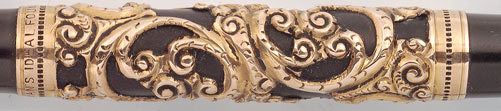
A more elaborate Filigree variant is shown above. "Chased Filigree", shown in Waterman's 1908 catalog, has an open scrolling pattern in relief.
Other patterns, not illustrated (yet): Plain (smooth), Wreath (Plain Wreath in 1908 catalog), Puritan/Patch (Patch in 1902, 1907 catalogs; Puritan in 1908 catalog, Patch in 1914 catalog, Puritan in 1919 catalog), Repoussé, Grecian.
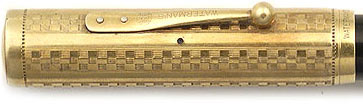
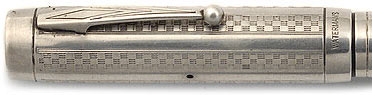
Gothic
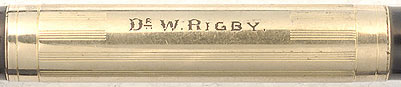
Sheraton (a less common variant with a very different handling of the indicia, normally only seen on pens for the French market, is shown below)
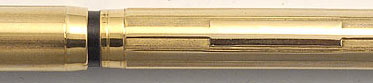
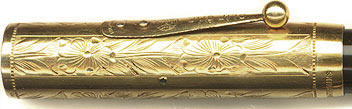
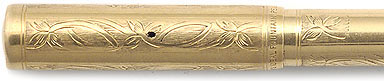

Three examples of Pansy Panel appear above. Note the differences in handling, with some versions much more extensively and naturalistically engraved.

Oriental
Colonial
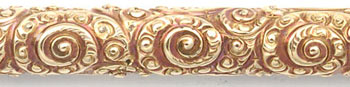
Chased

Scroll (smooth, with engraved framed cartouche)

Barleycorn ("Barley Corn" in the 1908 catalog). More popular in the UK than the USA.

Golph (also called Golpheresque)

Commercial (often referred to as "line-and-dot"), found almost exclusively on British-market Watermans.
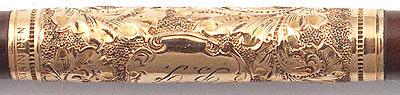
Majestic
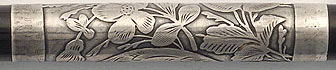
Above is a rare acid-etched floral pattern. It appears in the 1908 Waterman catalog as "Etched", offered on cone-cap pens only. It is most often found as a half-overlay, and in (unmarked) fine silver, though full overlay examples are known. By the time Waterman's 1919 catalog came out, "Etched" indicated an entirely different pattern, shown below, consisting of a lively, swirling carpet of engraved flowers and leaves.

This later pattern is normally found only on vest-length pens and on safeties, both short and full-length. The full-length slender lever-filler above was not catalogued in this pattern.

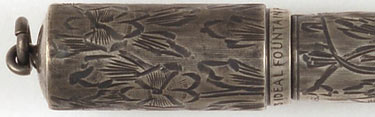

Hand Engraved Vine. This was the most expensive of the standard catalogued overlay patterns, and the only one catalogued with clips and levers engraved to match.

Indian Scroll.

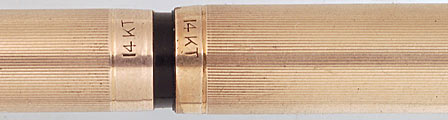
Moderne, an uncommon later pattern in USA production. In slightly different form, popular in France from the eyedropper era on (an example below); used also in the UK.
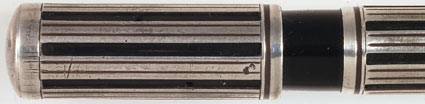
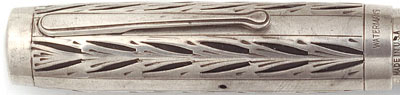
Bay Leaf, a scarce late pattern used only for the 494 and Lady Patricia.
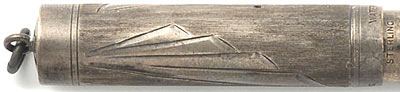
Duchesse, a rare pattern found only on late-production 452½V pens and matching pencils.
Waterman pens & pencils for sale: Eyedroppers -- Hard Rubber Self-fillers -- Plastics, c. 1929 to date